The House Failed to Override the President's Veto of his National Emergency Declaration
The House failed (248-181) to reach the 290 votes required to override the Presidents veto of a Senate passed resolution of disapproval formally admonishing Trump over his recent national emergency declaration. Twelve Republicans voted for the measure.
SUMMARY: Following is a summary of the vetoed measure. To override a presidential veto, a two-thirds vote of each chamber is required.
This resolution terminates the national emergency declared by President Trump on Feb. 15 regarding border security (Proclamation 9844) — which, if enacted, would prevent the president from using the planned $3.6 billion in previously appropriated military construction and family housing funding to build new barriers on the border with Mexico.
Terminating the national emergency declaration would not, however, impact the president's attempt to redirect $3.1 billion in other federal funding to wall construction, including $600 million from the Treasury Forfeiture Fund and up to $2.5 billion in Defense Department counterdrug funding.
BACKGROUND: Both the House and Senate considered and passed the measure through procedures set by the 1976 National Emergencies Act, under which congressional resolutions to terminate emergency declarations are privileged and cannot be filibustered. The House originally passed the measure on Feb. 26 by a 245-182 vote, after which the Senate on March 14 cleared it for the president by a 59-41 vote.
President Trump then vetoed the measure on March 18, saying that there "definitely is a national emergency" at the U.S.-Mexico border and that the emergency declaration was needed to ensure the border wall could be built.
Emergency Declaration
After Congress in February provided only $1.375 billion of the $5.7 billion the president requested for FY 2019 to build barriers on the U.S. border with Mexico, the president said he would redirect up to $6.7 billion in other federal funds toward construction of his proposed border wall — thereby providing a total of up to $8.1 billion that could be used to build his wall.
Specifically, the White House on Feb. 15 announced that using existing executive authorities it planned to use $600 million from the Treasury Forfeiture Fund (which collects criminal fines, penalties and forfeitures that can be used by the government for a variety of purposes) as well as up to $2.5 billion from the Defense Department's counterdrug activities account (the Section 284 Support for Counterdrug Activities account), with the expectation that other defense funds may first need to be reprogrammed into that account.
The president also signed a National Emergency declaration under the 1976 National Emergencies Act (PL 94-412) which declared that a national emergency exists at the U.S. southern border that requires the use of U.S. military troops and the redirection of military construction funding to support those troops — with plans to allocate up to $3.6 billion in previously appropriated military construction funding to build the wall.
(Under the 1976 National Emergencies Act, the president may declare a national emergency that invokes specified national emergency authorities enacted as part of other laws. Section 2808 of U.S. Code Title 10 allows the president, in any declared national emergency that requires the use of U.S. armed forces, to undertake any military construction project not otherwise authorized by law that is deemed necessary to support those armed forces using unobligated military construction and family housing funds.)
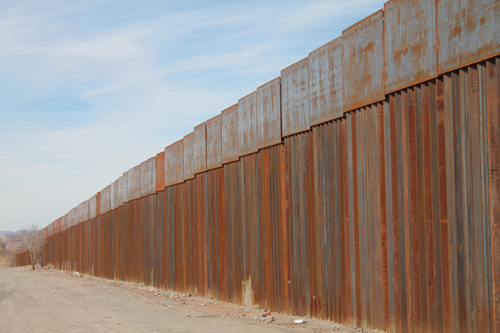
Under the administration's plan, the funds would be spent sequentially in order to build at least 234 miles of border barrier (reportedly a steel bollard "wall"), starting with the $1.375 billion appropriated by Congress for border barriers and ending with the $3.6 billion in military construction funding made available by the national emergency declaration.
Response
Democrats strongly opposed the president's actions, arguing there was no emergency at the border and that the president was taking an unconstitutional action by usurping Congress' "power of the purse" after Congress had previously limited funding for border barriers. House Democrats subsequently moved to consider a resolution to terminate the emergency declaration, as allowed under the 1976 National Emergencies Act. Most Republicans supported the president, arguing that the situation at the U.S.-Mexico border did constitute an emergency and that the president was simply using authorities granted by Congress — although many also expressed misgivings regarding the president's use of emergency authority, in particular regarding the precedent it could set.
In the end, all House and Senate Democrats voted for the resolution to terminate the emergency declaration. They were joined by 13 Republicans in the House and 12 in the Senate.
Lawsuits to block the emergency designation have been filed by more than a dozen states and by various nonprofit groups, but no actions have yet been taken by any court. Meanwhile, the Defense Department on March 18 provided to Congress a list of all unobligated military construction funding, noting that no decision had yet been made with regard to either the border barrier projects that will be built using military construction monies or which such funds will be used. However, the department stated that no funding for military housing, barracks or dormitory projects would be impacted.
(See House Action Reports Legislative Week of February 25, 2019, for further background on the border wall funding issue and the arguments made for and against the termination resolution.)
AMENDMENTS: None permitted.
COMMENTARY: President Trump vetoed the measure on March 18, saying there "definitely is a national emergency" at the U.S.-Mexico border and that the emergency declaration was needed to ensure the border wall could be built.
In his veto message, the president stated that the "situation on our border cannot be described as anything other than a national emergency, and our Armed Forces are needed to help confront it." He stated that "our porous southern border continues to be a magnet for lawless migration and criminals and has created a border security and humanitarian crisis that endangers every American." Highlighting statistics regarding illegal drugs that enter the United States through the southern border and the crimes committed in the U.S. by undocumented immigrants, and saying that a "rapidly deteriorating" situation exists because increasing numbers of families and unaccompanied children from Central American nations are being released into the U.S., the statement said that "H J Res 46 ignores these realities. It is a dangerous resolution that would undermine United States sovereignty and threaten the lives and safety of countless Americans."
Block Emergency Declaration Veto Override
The House will vote to override the president's veto ofH J Res 46, Terminate President's Emergency Border Declaration . The measure terminates the national emergency declared by President Trump on Feb. 15 regarding border security, which if enacted would prevent the president from using a proposed $3.6 billion in previously appropriated military construction funding to build new barriers on the border with Mexico. The president, unhappy that Congress in the final FY 2019 spending law didn't provide the full $5.7 billion he wanted for border wall construction, declared the border emergency under the 1976 National Emergencies Act in order to redirect the military construction funding; he also plans to redirect another $3.1 billion in other federal funding, which would not be affected by terminating the emergency declaration. The president vetoed the measure March 18; a two-thirds vote of both chambers is needed to override a veto.
Do you think Congress should override President Trump's veto of H.J.Res. 46, that would block his declaration of a national emergency at the southwest border?