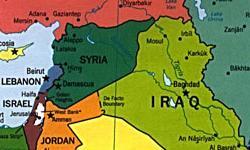
Strengthening America's Security in the Middle East - S.1
The Senate passed a bill that would authorize $3.3 billion annually in foreign military financing to Israel through fiscal year 2028, codify the 2016 Memorandum of Understanding with Israel related to security assistance, extend war reserve stockpile access and loan guarantees for Israel through fiscal year 2023, and authorize a U.S.-Israel joint project to counter unmanned aerial vehicles. It would extend the president's authority to expedite and waive certain surcharges on defense sales to Jordan through 2022 and would order a report on the establishment of an enterprise fund to support economic development in Jordan. It would direct the president to impose sanctions on the Syrian government and entities that support or do business with the government, including financial penalties and denying or revoking U.S. visas, and would order a Treasury Department report on money laundering by the Central Bank of Syria. It would allow state and local governments to enact measures divesting from or restricting contracts with entities whose commercial activity is intended to economically harm or limit commercial relations with Israel for purposes of coercing political action or policy of the Israeli government. As amended, it would call for increased international stabilization efforts in Syria and Afghanistan, call for the administration to review military and diplomatic strategies in these nations, and request that no "significant withdrawal" of U.S. forces occur until conditions have been met for the "enduring defeat" of al Qaeda and ISIS.
Senators considered a long-stalled foreign policy measure, S. 1 — and, along with it, an amendment that would express the chamber's disapproval of the withdrawal of U.S. troops from Syria and Afghanistan.
The vote on the Amendment came two days after the highest-ranked U.S. intelligence officials, including Director of National Intelligence Dan Coats and CIA Director Gina Haspel, testified to Congress that the Islamic State remains a powerful presence in Iraq and Syria and that withdrawing American troops will create a power vacuum and allow the group to regain land.
Their statements riled President Donald Trump, who has expressed intent to bring the soldiers stationed there home. He tweeted Wednesday that his own intelligence chiefs need to "go back to school."
NOTEWORTHY
Background: In the 115th Congress, a number of bipartisan foreign policy measures were not enacted despite passing one or both Houses of Congress easily. Senators Rubio, Risch, McConnell, Gardner, and Blunt combined four of these bills into the Strengthening America’s Security in the Middle East Act of 2019.
Floor Situation: The bill sponsors bypassed committee jurisdiction over this bill and moved it to the Senate floor under Rule 14.
Executive Summary: The bill authorizes security assistance and increased cooperation with Israel, extends cooperation with Jordan, imposes new sanctions on entities doing business with the government of Syria, and protects state and local governments in opposing anti-Israel boycotts.
CONSIDERATIONS ON THE BILL
The bill is composed of four bills from the 115th Congress.
1. United States-Israel Security Authorization Assistance Act of 2018 (S. 2497)
Senate passed by voice vote on August 1, 2018. Passed House with amendment by voice vote on September 12, 2018.
2. United States-Jordan Defense Cooperation Extension Act (H.R. 2646)
House passed by voice vote on February 5, 2018. Reported favorably by the Foreign Relations Committee on November 29, 2018.
3. Caesar Syria Civilian Protection Act of 2018 (H.R. 1677)
Passed by House in voice vote on May 17, 2017. Reported favorably by the Foreign Relations Committee on October 3, 2018.
4. Combating BDS Act of 2018 (S. 170)
Hotlined by the Banking Committee on November 28, 2018. So far, 26 states have adopted laws or executive orders on boycotts, divestment, or sanctions that would be protected under this bill.
NOTABLE BILL PROVISIONS
TITLE I — UNITED STATES-ISRAEL SECURITY ASSISTANCE AUTHORIZATION ACT
Section 113 – Assistance for Israel
Authorizes $3.3 billion per year for the next 10 years in U.S. security assistance in foreign military financing to Israel.
Section 131 – Ensuring Israel’s qualitative military edge
Continues the policy of the United States to ensure Israel can counter threats by having military weapons and equipment that are superior to those possessed by its enemies.
TITLE II — UNITED STATES-JORDAN DEFENSE COOPERATION EXTENSION
Section 204 – Reauthorization of United States-Jordan Defense Cooperation Act
Continues streamlined and accelerated defense sales to Jordan until December 31, 2022.
TITLE III — CAESAR SYRIA CIVILIAN PROTECTION ACT OF 2019
Section 311 – Measures with respect to Central Bank of Syria
Requires the Department of the Treasury to determine if the Central Bank of Syria is a financial institution of primary money laundering concern.
Section 312 – Sanctions on foreign persons that engage in certain transactions
Sanctions anyone doing business or financing with the Government of Syria. Specifically prohibits anyone from providing aircraft or spare parts for aircraft that are used for military purposes in Syria on behalf of the Syrian government. The bill also sanctions anyone who provides services to Syria’s telecommunications or energy industries.
Section 331 – Suspensions of sanctions
Allows the president to stop sanctions on entities affected by this bill if the Syrian government:
stops the violence against the Syrian people;
allows international humanitarian access;
releases political prisoners;
complies with agreements on chemical weapons; and
permits the safe, dignified, and voluntary return of displaced Syrians.
TITLE IV — COMBATING BDS (BOYCOTT, DIVESTMENT, AND SANCTIONS) ACT
Section 402 – Non-preemption of measures by state and local government
Protects a state or local government that adopts or enforces a measure to divest its assets from, prohibit investment of its assets in, or restrict contracting with an entity that engages in boycott, divestment, or sanctions activity targeting Israel.
Clarifies that these measures adopted or enforced by a state or local government are not preempted “by any federal law” if they comply with the requirements in the legislation.
ADMINISTRATION POSITION
The administration is not expected to oppose the bill.
The State Department previously issued descriptions and support for the Memorandum of Understanding for Israel and the Memorandum of Understanding for Jordan.
COST
In the 115th Congress, CBO issued the following scores on previously filed bills.
United States-Israel Security Assistance Authorization Act (S. 2497)
“CBO estimates that implementing S. 2497 would cost $16.5 billion over the 2019-2023 period, and $16.5 billion after 2023, assuming appropriation of the authorized amounts. Enacting the bill would affect direct spending, although the net effect over the 2019-2028 period would be negligible.”
United States-Jordan Defense Cooperation Extension Act (H.R. 2646)
“Enacting H.R. 2646 would not affect direct spending or revenues; therefore, pay-as-you-go procedures do not apply. CBO estimates that enacting H.R. 2646 would not increase net direct spending or on budget deficits in any of the four consecutive 10-year periods beginning in 2028.”
Caesar Syria Civilian Protection Act of 2018 (H.R. 1677)
“CBO estimates that implementing H.R. 1677 would cost $3 million over the 2019-2023 period, subject to the availability of appropriated funds.”